
Searching Bolivar County Civil Dockets
Figure out which court holds the case before you type a name anywhere. Bolivar County's public-records routing page steers civil litigation to the Circuit Clerk. The Chancery Clerk takes divorce, estates, land, delinquent taxes, and Board of Supervisors minutes and orders. Get that divide right first. It decides where your docket search even begins.
Circuit or County Court activity starts electronically. The Eleventh Circuit MEC page and the PAMEC account route are the electronic starting points. Chancery searching uses the correct Cleveland or Rosedale clerk-linked form as a locating aid. Write down the court. Note the district, party style, filing date, and the exact case or instrument number. One caution: no published source lays out a single case-number grammar for Bolivar County. Also note that First and Second Judicial District are local location labels. They are not separate appellate courts.
- Read the filing, order, or notice for the court, district, and record type.
- Use the Eleventh Circuit MEC route for Circuit or County Court, or the correct Chancery index for a Chancery matter.
- Narrow a party-name result with a style, date, file number, or other field the form actually shows.
- Record the displayed district and identifiers before moving between electronic systems.
- Request an official or certified document from the clerk who keeps that court’s record.
Bolivar County Civil Court Routes
Civil records in Bolivar County divide by subject and by clerk. Circuit Court hears civil litigation within its jurisdiction. Chancery is the route for divorce, estates, land, delinquent taxes, and equity or domestic-relations matters. County Court shares jurisdiction with Circuit and Chancery up to $200,000. The Circuit Clerk also describes its specific jurisdiction. A caption helps. But the filing court controls the docket route.
The Bolivar County Chancery Clerk lists separate Cleveland and Rosedale offices. Its public page confirms which clerk keeps a filed record.
The clerk split is a practical warning. A civil record may not sit in the Circuit Clerk's files even when both courts use the county's two district locations.
| Civil matter | Likely local route | Custodian check |
|---|---|---|
| Civil litigation | Circuit Court | Circuit Clerk and Eleventh Circuit MEC |
| Divorce, estate, land, equity | Chancery Court | Chancery Clerk and Seventh Chancery MEC/index |
| Qualifying concurrent matter | County, Circuit, or Chancery Court | Use the court named in the filing |
| Municipal or Justice Court case | Issuing lower court | Do not assume a Circuit Clerk docket |
Inside a Bolivar County Civil Docket
Think of a civil docket as the dated activity log behind a case. It can show the court and the location. It also lists the parties or style, the filing event, motions, settings, notices, orders, and a final date. Displays vary by system, though. MEC terms cover docket sheets, documents, and notices. The Chancery forms expose search fields instead of a complete case register.
| Case or file identifier | Copy it exactly. The public forms do not explain a universal Bolivar County number format. |
|---|---|
| Party style | Names shown as plaintiff, defendant, grantor, grantee, or another role, depending on the record. |
| Filed or final date | A search or docket field that needs the order or entry for full context. |
| Docket or book/page | A case-activity or index reference, not necessarily a complete filed document. |
| Setting or order | A scheduled event or court action that should be confirmed with the current record. |
A final disposition date is not a plain-language outcome. It marks a date field you must read with the docket entry or filed order beside it.
Note: A field label or index result can locate a civil matter, but the docket entry or official document supplies the legal context.
Bolivar County Civil Docket Search Fields
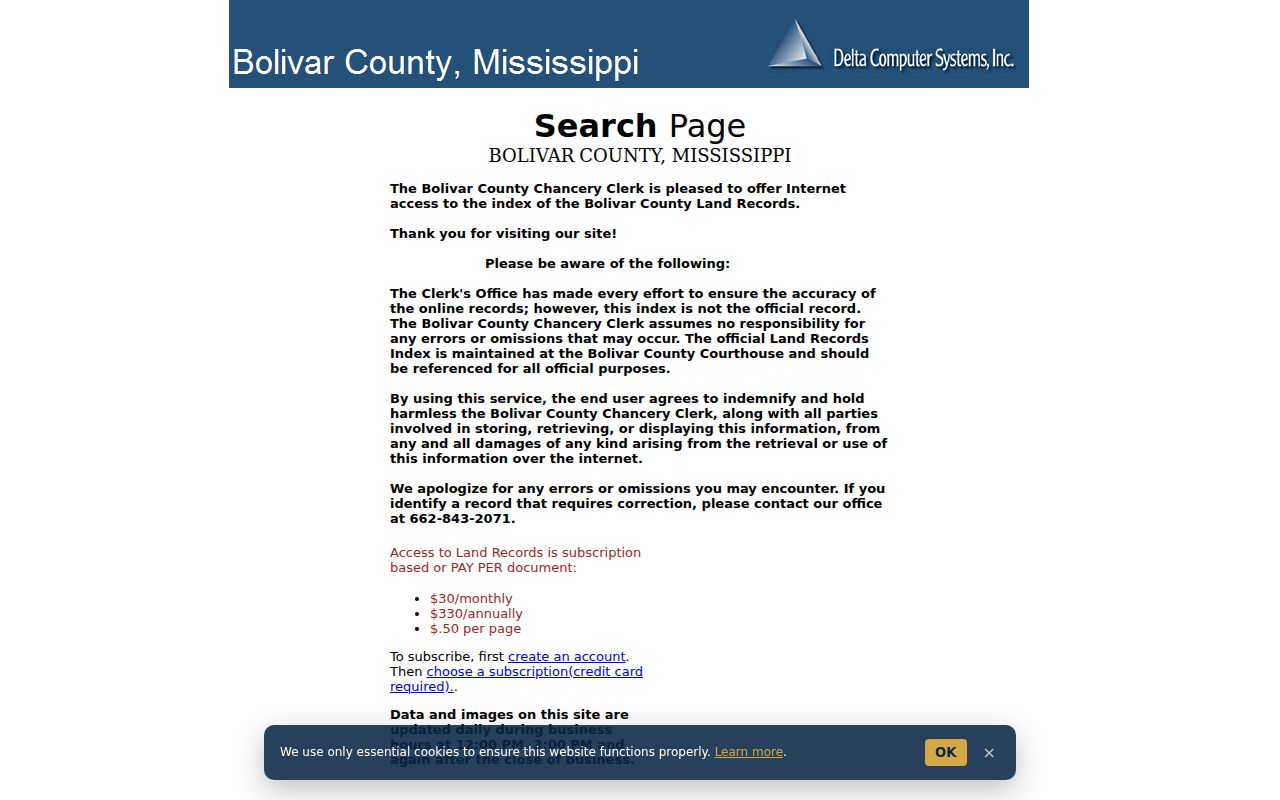
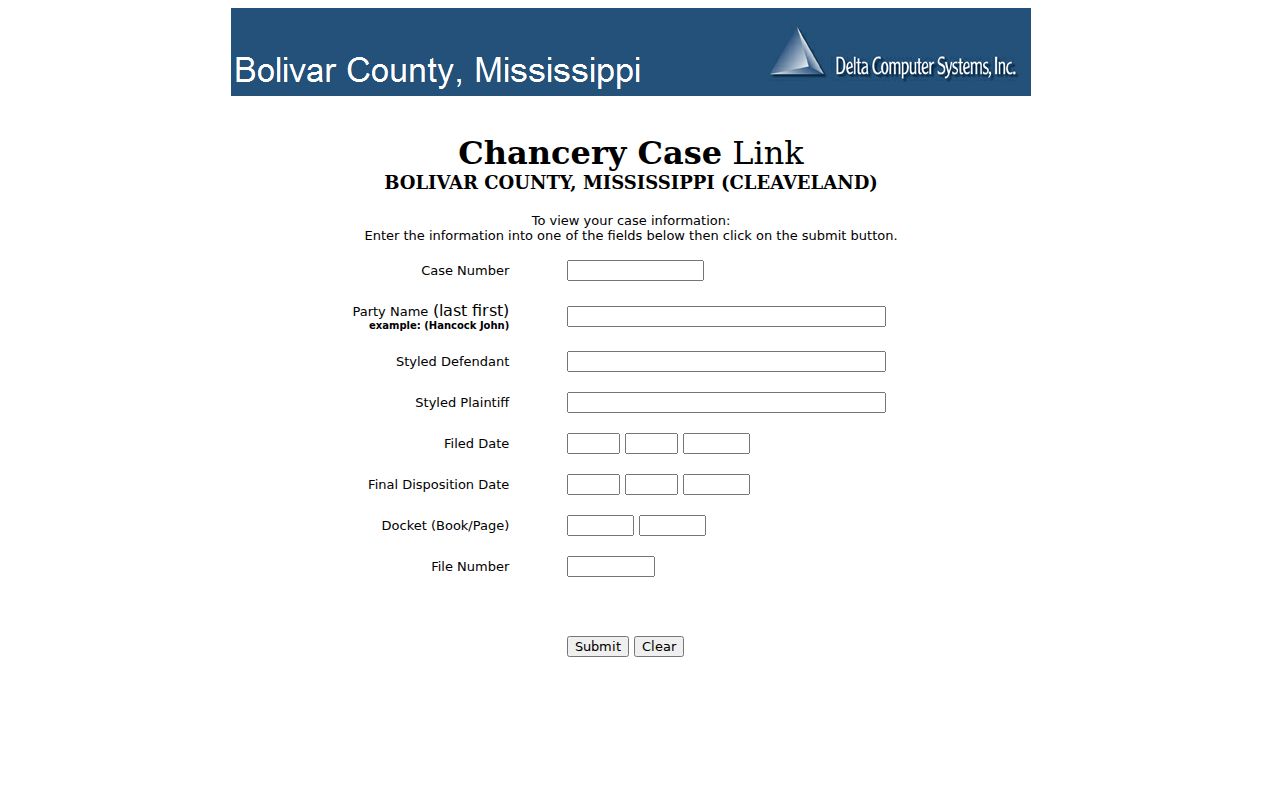
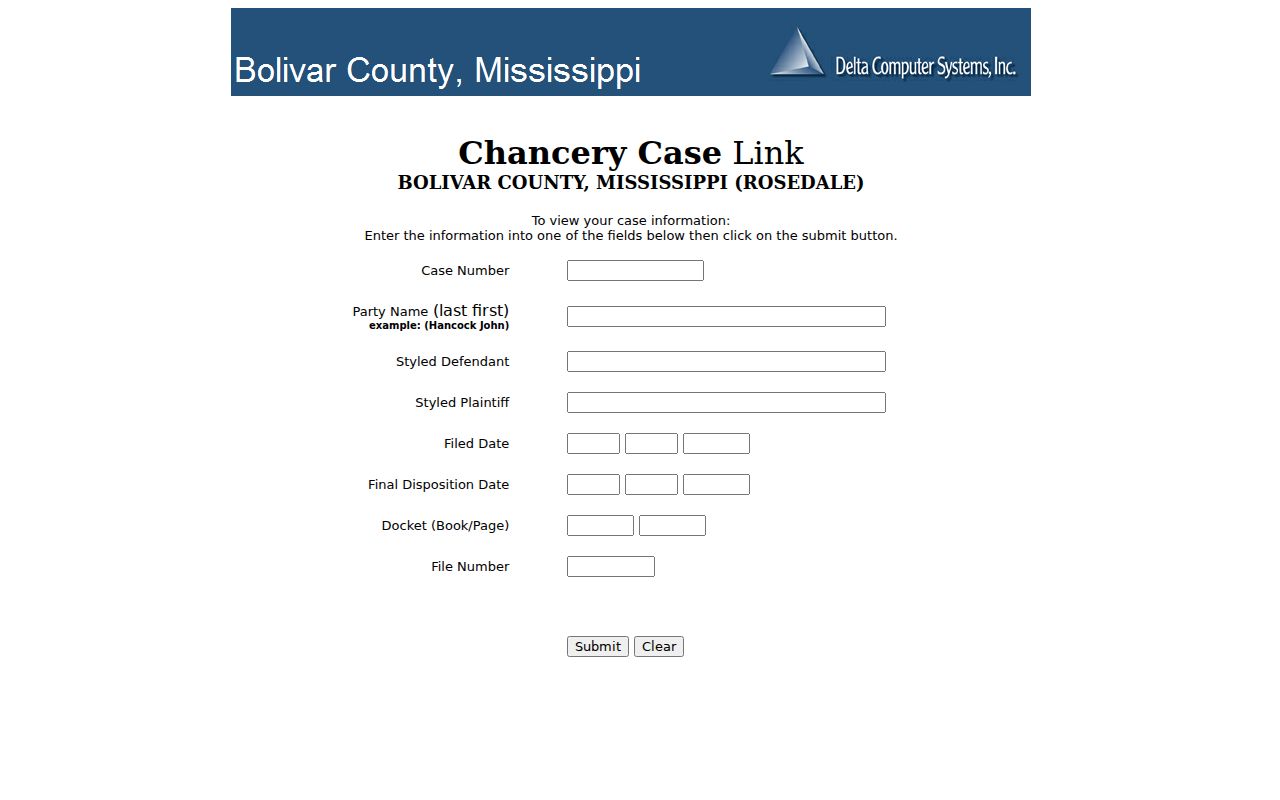
The Bolivar County Chancery Clerk links to a Delta Computer Systems index home. It offers distinct Cleveland and Rosedale options. The divorce and estate forms expose case-number components. They also expose party name, styled plaintiff and defendant, filed date, final disposition date, docket or book-page, and file number. The form never defines the case-number grammar. Use an exact number from the record rather than guessing at what the components mean. The clerk-linked Chancery index home keeps the location-specific searches separate.
Picking the location narrows a request to First/Rosedale or Second/Cleveland first. That way a name result earns more trust as a match. The Cleveland divorce and estate form shows the public field set for second-district searching.
Common names need more than a name-only match. These fields let you narrow by style, date, docket reference, or file number. The Rosedale divorce and estate form offers the parallel first-district route.
Save the district and file details from any result.
Civil Case Types on the Docket
The Circuit Clerk's own terminology runs from breach of contract or warranty to construction injuries, contributions, creditors' rights, custody, declaratory judgment, detinue, foreclosure, class actions, and condemnation. Chancery differs. It keeps its own domestic, estate, land, and equitable categories. Treat these labels as index aids only. The complaint, petition, or order still says what the case asks the court to decide.
- Contract and warranty disputes within the filing court’s jurisdiction.
- Property matters, including foreclosure, detinue, and land-record issues.
- Domestic-relations and custody matters assigned to Chancery.
- Estate, guardianship, and related Chancery proceedings.
- Condemnation, declaratory judgment, and other named civil categories.
The Cleveland deed search form lets you query by grantor or grantee, book and page, filing date, and legal description. Subdivision, block, lot, and instrument controls narrow the results too. The page itself shows every field the clerk indexes.
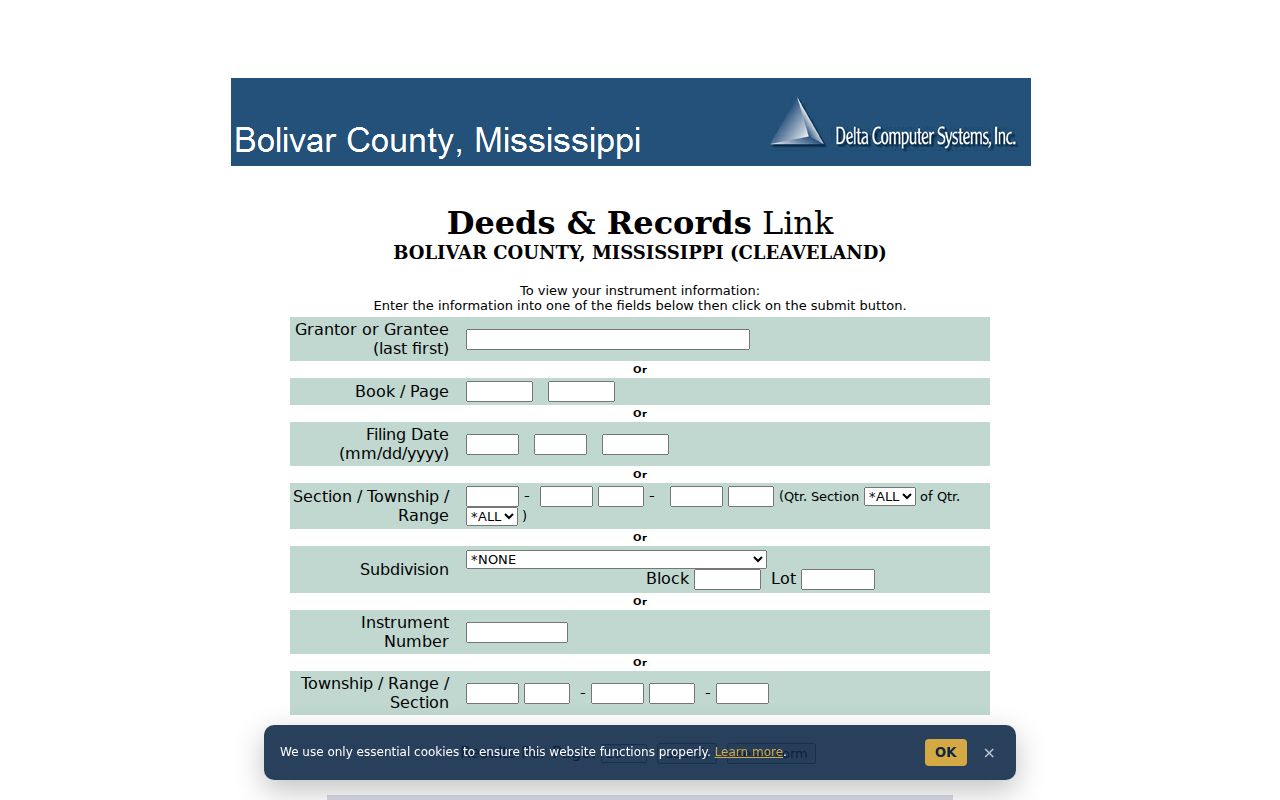
Land-index fields help you find a record. They do not shift the clerk's role as source for a controlling document.
Bolivar County Civil Jurisdiction Note
Bolivar County Court handles more than small claims. Its jurisdiction runs alongside Circuit and Chancery Courts for civil matters up to $200,000. It also has exclusive jurisdiction over eminent-domain and juvenile matters, and shares jurisdiction with Justice Court. It alone handles unlawful-entry-and-detainer cases. That published statement is a routing tool, nothing more. It is not legal advice for any specific filing.
County Court and Circuit Court stay separate courts. The same clerk may serve both locally. Before you treat a civil setting or case number as a Circuit Court record, read the case heading. A court order or a note from the clerk works too.
Note: The jurisdiction summary can help route a question. For an individual civil matter, the filed case and current court instructions control.
Civil Docket Settings and Hearings
A Bolivar County civil setting tells you what the court has scheduled. It may be a motion hearing. It could be a status conference or the trial itself. Read it beside the court, district, date, time, and the current order. One caution matters here. A date on the docket is not automatically the hearing date, and an earlier setting may have been continued, reset, or replaced. The county posts no single verified calendar covering every court. So plan on confirming by phone or in person. For Bolivar County Circuit or County Court, take the correct MEC route. Then verify the setting with the Circuit Clerk. Chancery cases go through the Bolivar County Chancery Clerk and the Seventh Chancery MEC route. General session patterns can help you time a call. But the summons, the order, the current docket entry, or the clerk's confirmation is what controls.
Bolivar County Civil Copy Fees
Copy costs depend on which clerk holds the record. The Bolivar County Circuit Clerk's published schedule, effective July 1, 2024, sets staff copies at $1 per page. Self-service copies cost $0.25 per page. Fax or email delivery runs $1.50 for up to three pages, and a certified court document with the official seal is $1.50 per document. A ten-year record search costs $10. The same schedule lists a $160 new-case filing charge, which is a filing cost rather than a copy price, so confirm the current fee and scope with the clerk before you rely on any figure. On the Chancery side, the clerk's page notes a 2.35% card fee. Its linked land portal offers $30 monthly or $330 annual subscriptions, plus $0.50 per document page. Chancery publishes no full copy or certification table. Ask the Chancery Clerk for the exact amount before you authorize a request.
Civil Docket Access Rules
Mississippi's public-record framework governs any Bolivar County civil request. That means reasonable written procedures, fees, exemptions, and rules tied to each court. Miss. Code §§25-61-5 and 25-61-7 lay out the public-record process. Miss. Code §9-1-38 marks the judicial-record boundary. A partial nonexempt record can be released after redaction. Even so, a civil docket does not open every attachment, address, or protected filing to the public.
Request detail matters: State the custodian, court, district, case or instrument number, date range, document, copy type, and delivery preference. Ask for a fee estimate before paying for a search, copy, or certification.
Go to the Chancery Clerk for an official Chancery document. Circuit or County civil records belong to the Circuit Clerk, and a vendor index result is never a certified court record.
Bolivar County Civil Index Limits
The Chancery portal states it plainly. Its online land index is not the official Land Records Index. A hit there can help you locate a deed, a divorce, an estate file, or another filing. It proves nothing more. The portal does not tell you which. A result may be incomplete, outdated, sealed, or legally void. For anything official, the courthouse index and the clerk still control. The Rosedale deed search form carries the same general land-record controls, plus a dropdown of local subdivisions.
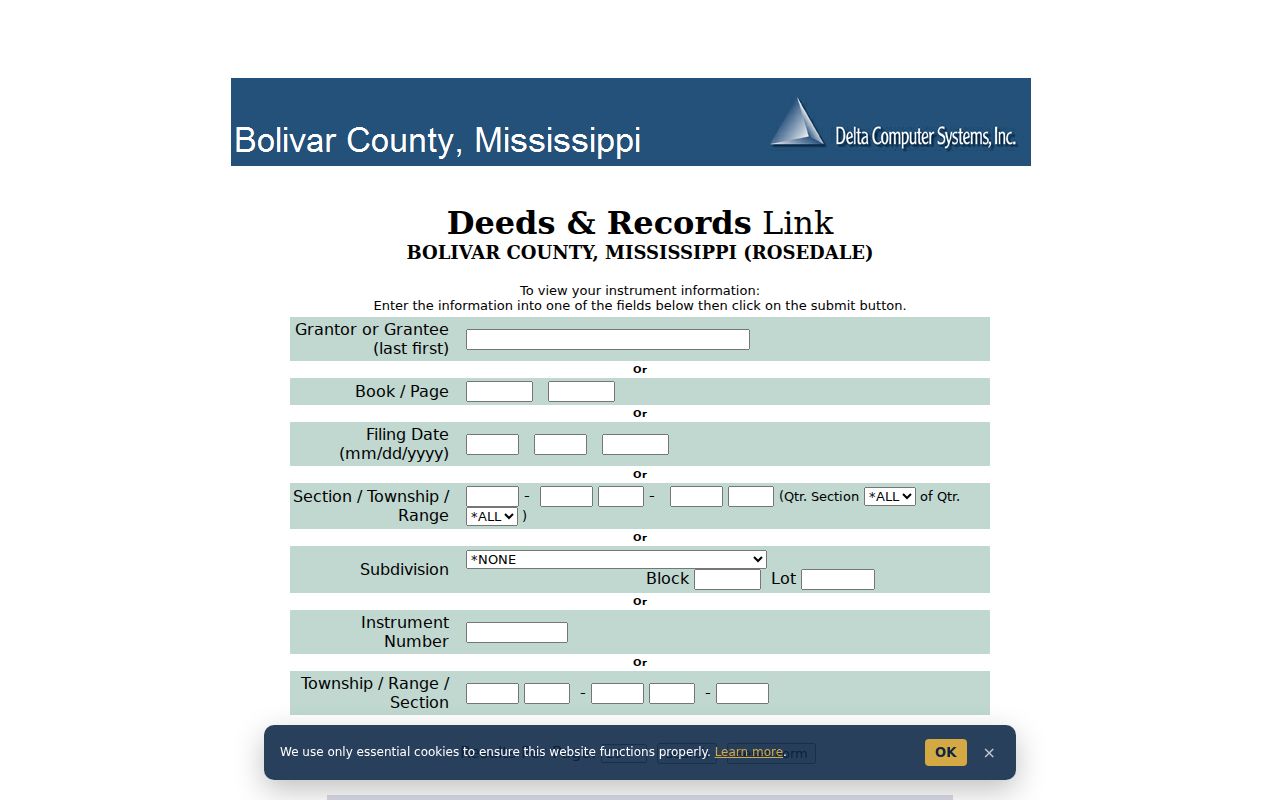
Narrow the index with what you already know. Use a grantor, grantee, instrument number, book and page, date range, or legal description. Then ask Chancery for the official document or a certification. Keep the limit in mind. A civil index result is a starting point for a record request, never a substitute for the filed order, deed, decree, or clerk-certified copy.